




Now Reading: Mumbai Airport Rolls Out AI-Driven Security Systems Amid Global Aviation Changes
-
01
Mumbai Airport Rolls Out AI-Driven Security Systems Amid Global Aviation Changes
Mumbai Airport Rolls Out AI-Driven Security Systems Amid Global Aviation Changes
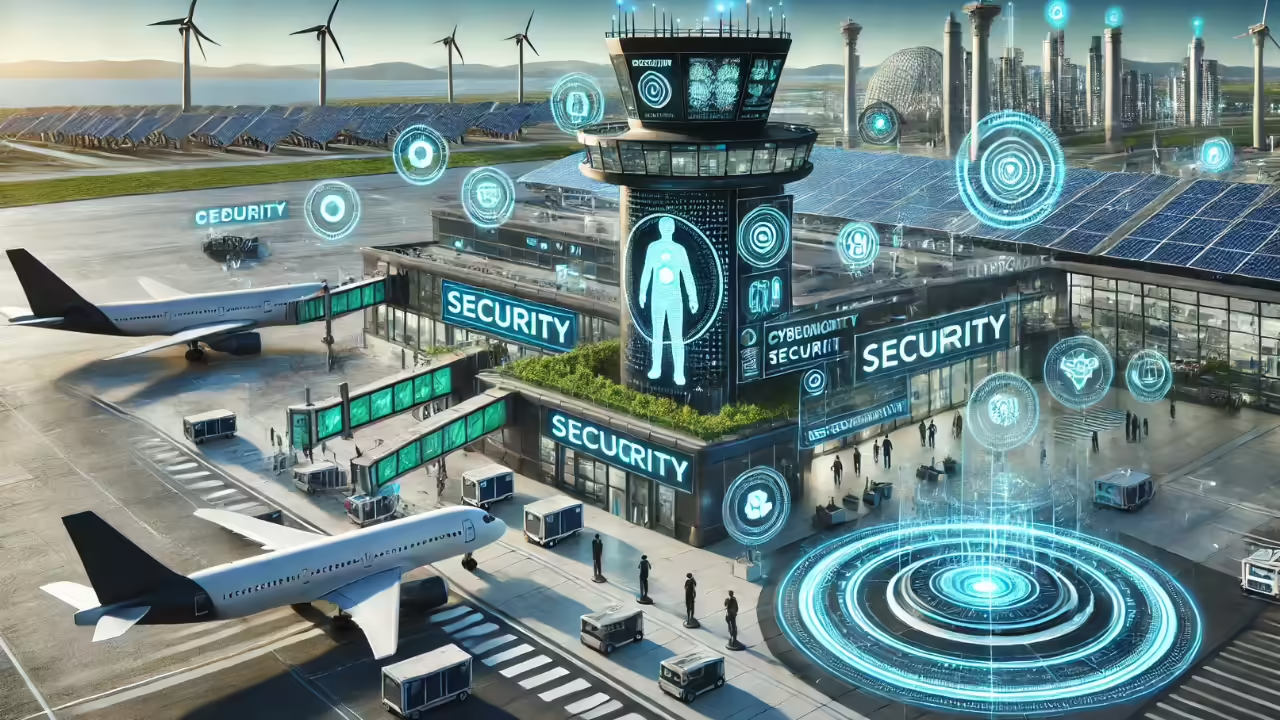
Mumbai’s Chhatrapati Shivaji Maharaj International Airport (CSMIA) has ramped up its security infrastructure with AI-driven systems to align with evolving global aviation standards. The integration of advanced surveillance, biometric screening and real-time operations platforms marks a shift in how Indian airports address security, efficiency and passenger experience.
New AI Surveillance and Biometric Screening at CSMIA
The airport has started deploying AI-enabled cameras across critical zones to detect suspicious behaviour, manage crowd flows and support 24/7 monitoring. Combined with biometric check-ins through the national Digi Yatra initiative, the aim is to reduce manual security checks while strengthening threat detection. Entry lanes, e-gates and facial-recognition systems are now standard at the land-side and terminal access points, speeding up processing while maintaining heightened vigilance.
Integrated Operations Control to Support Security and Efficiency
CSMIA’s recently upgraded Airport Operations Control Centre (AOCC) now merges data from airside movements, terminal operations and security feeds. The real-time platform offers airport-wide situational awareness, enabling rapid response to anomalies and aligning security protocols with operational demands. This unified approach reflects global aviation trends where security is integrated into the broader operations ecosystem rather than treated as a standalone issue.
Addressing Global Aviation Threats and Local Challenges
With threats evolving—from unmanned aerial vehicles near airports to cyber intrusions—CSMIA’s security strategy responds to both physical and digital risks. Enhanced AI-monitoring systems, predictive analytics and automated alert systems help identify irregular activity early. At the same time, passenger volumes at CSMIA are rising, so streamlining security without compromising safety becomes crucial. Faster screening, better queue management and digital identification are part of the solution for handling growth while maintaining high security standards.
Implications for Passengers and Industry Stakeholders
Weighing in for travellers, the changes mean shorter wait times, fewer manual verifications and an overall smoother airport experience. For airlines and ground handlers the linked security and operations systems promise fewer disruptions and better resource utilisation. Regulators and infrastructure planners will now look at CSMIA’s model as a blueprint for future airports. Investment in AI-security tools not only enhances safety but can yield operational savings and improved throughput over time.
Takeaways
- CSMIA has begun full deployment of AI-enabled surveillance and biometric screening to raise security standards.
- Real-time integrated control via the AOCC links security with airport operations, aligning with global aviation trends.
- The dual focus on passenger experience and threat management responds to rising volumes and evolving risk profiles.
- The Mumbai airport’s approach offers a roadmap for other Indian airports to balance efficiency, safety and growth.
FAQs
Q: What AI security systems are being used at Mumbai airport?
A: The airport is using AI-driven cameras for behaviour analysis, facial-recognition biometric gates, and an integrated operations platform that monitors terminal, airside and security metrics in real time.
Q: How will these systems affect passenger wait times and check-in?
A: They will reduce manual verification steps via biometric gates and automated checks, which should lower queue times and streamline boarding processes.
Q: Are these upgrades all about security or also about operations?
A: Both—they enhance security while also improving operational efficiency by linking resource allocation, ground movement monitoring and passenger flow into one platform.
Q: Could this model be replicated at other Indian airports?
A: Yes. The Mumbai airport’s deployment of AI-driven security and integrated operations is seen as a benchmark for other airports in India to adopt similar systems.