







Now Reading: India Plans Next Gen Fighter Jet Ecosystem After Record Defence Production
-
01
India Plans Next Gen Fighter Jet Ecosystem After Record Defence Production
India Plans Next Gen Fighter Jet Ecosystem After Record Defence Production
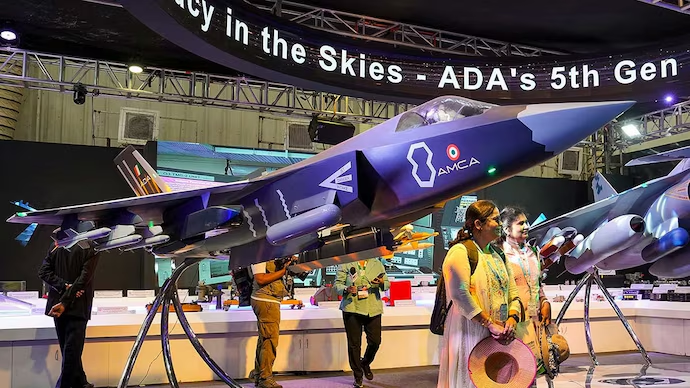
India is moving into a new phase of defence capability building, with the government outlining an accelerated push for a next gen fighter jet ecosystem after achieving record defence production. The main keyword next gen fighter jet ecosystem reflects the national shift from import dependence to domestic innovation.
India’s defence production crossed record levels in the last financial year, driven by ramped up manufacturing of aircraft, helicopters, missiles, sensors and advanced electronics. This performance has created the foundation for India’s next strategic leap: building an indigenous ecosystem capable of designing, testing and manufacturing advanced combat aircraft for the coming decades.
Record output sets the base for advanced platforms
India’s defence production growth is not a one year anomaly. The country has consistently expanded its manufacturing capacity across public and private sector units. The rise comes from multiple factors including higher orders placed by the armed forces, policy incentives that favour local manufacturing and rising participation from private companies and start ups.
This production base now supports more complex systems. With assembly lines for trainers, helicopters and light combat aircraft maturing, the government believes the transition to next generation fighters is technically feasible. The success of the Light Combat Aircraft Tejas, which has moved from initial operational clearance to active deployment, is often cited as evidence that India can manage complete aircraft development cycles. The ecosystem around avionics, radars, composites and engine components is deeper today compared to a decade ago.
India’s fighter jet ambitions gain clarity
The next phase focuses on developing a fighter jet with advanced stealth, sensor fusion and high endurance. The project aims to reduce dependence on imported fighters and give India operational autonomy. The programme includes plans for a fully indigenous airframe, an upgraded engine pathway and a testing ecosystem that supports faster iterations.
Alongside the main platform, India is preparing the supply chain that a next gen fighter requires. This includes capability expansion in electronics manufacturing, materials science, flight testing infrastructure and cyber secure communication systems. The long term goal is to ensure that upgrades can be developed internally rather than relying on foreign suppliers.
Strengthened supply chain for strategic independence
A next gen fighter is not built by one manufacturer. It depends on hundreds of suppliers specializing in microelectronics, mission systems, propulsion components, precision machining and composite structures. India’s rapid expansion in defence electronics and dual use technologies is enabling the supply base needed for this capability.
Private sector players are increasingly producing mission critical subsystems such as cockpit displays, flight control computers, antennas and high precision parts. State run research institutions and laboratories have moved from prototype development to early industrial scale readiness. The direction is clear: India wants a vertically integrated ecosystem rather than isolated pockets of excellence.
As global geopolitical tensions remain high, the strategic importance of defence self reliance has grown. Countries that control their air combat platforms gain flexibility in foreign policy and reduce vulnerability to supply chain disruptions.
Technology challenges and planned timelines
The upcoming fighter project carries significant technological demands. Engine development remains a long term challenge, as high thrust and high temperature performance require specialized metallurgical capabilities. India is working on partnerships and domestic programs but full scale indigenous engine development will take time.
Stealth technologies also demand precision manufacturing and new materials. The ecosystem must support radar absorbing coatings, embedded antennas, internal weapon bays and fuselage shaping techniques.
Timelines for such aircraft typically stretch over a decade from design to first flight to squadron level deployment. India is setting aggressive but realistic milestones by parallelizing subsystem development and using digital design tools to reduce delays.
The government has signaled that the programme will remain a long term national priority, insulated from short term budget cycles.
What this shift means for the defence sector
India’s target is not just one fighter jet. The ambition is to create an aerospace capability that can produce successive generations of combat aircraft. This strategy mirrors the pathways followed by major aviation powers that built deep technological foundations through multi decade investment.
For domestic industry, the opportunity is substantial. Suppliers involved in composites, microelectronics, control systems, advanced sensors and weapons integration could see steady multi year demand. The skills required for next gen fighters also translate into civilian aviation, drones, and deep tech sectors.
For the armed forces, a successful ecosystem would reduce long maintenance cycles, improve availability rates, and allow customized upgrades based on India’s operational needs.
Takeaways
- Record defence production has created a strong foundation for India to move into next gen fighter development.
- The new ecosystem approach focuses on airframe, engines and avionics, supported by a rapidly expanding supply chain.
- Strategic autonomy is a key driver, as India aims to reduce dependence on foreign suppliers for critical combat platforms.
- Timelines remain long but structured, with parallel development to accelerate testing and deployment.
FAQs
Q: Why is India focusing on a next gen fighter jet now?
A: Record defence production and maturing aerospace capabilities have enabled India to aim for a more advanced and self reliant combat aircraft programme.
Q: What technologies will the new fighter include?
A: Likely features include stealth shaping, sensor fusion, advanced avionics, internal weapons carriage and improved endurance.
Q: Can India develop its own engine for this fighter?
A: Engine development is still a long term challenge. India is pursuing domestic R&D and global collaboration pathways but full indigenous capability will take time.
Q: How will the ecosystem benefit industry?
A: Hundreds of suppliers in electronics, composites, precision engineering and mission systems stand to gain from long term contracts and capability building.