








Now Reading: ISRO Prepares For Key Gaganyaan Crew Module Test
-
01
ISRO Prepares For Key Gaganyaan Crew Module Test
ISRO Prepares For Key Gaganyaan Crew Module Test
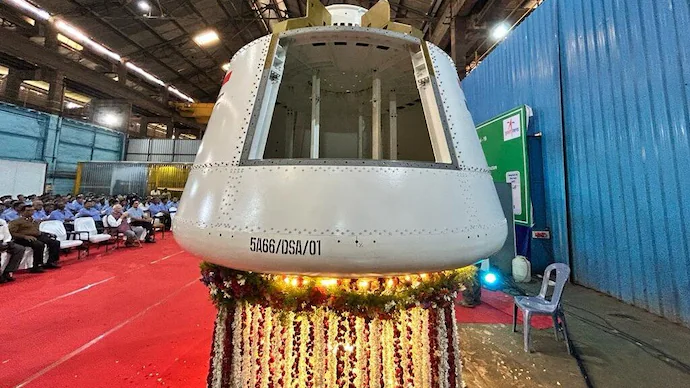
ISRO is preparing for a key Gaganyaan crew module test as part of India’s first human spaceflight programme. The upcoming test is a critical milestone to validate crew safety systems before astronauts are sent into low Earth orbit.
The Gaganyaan crew module test is time sensitive and marks a decisive phase in India’s human spaceflight roadmap. The Indian Space Research Organisation is moving into advanced validation of systems designed to protect astronauts during launch, ascent, and emergency escape scenarios.
Why The Crew Module Test Matters For Gaganyaan
The crew module is the heart of the Gaganyaan mission. It is the pressurised capsule that will carry astronauts to space and bring them back safely to Earth. The upcoming test focuses on validating the module’s structural integrity, thermal protection, avionics, and life support interfaces under simulated mission conditions.
ISRO has already completed multiple uncrewed tests, but this phase is about refining safety margins. The crew module must withstand extreme vibration, acceleration, and temperature changes. Any failure at this stage could delay the programme, making this test a major checkpoint before full mission readiness.
What The Upcoming Test Will Validate
The planned test will primarily evaluate the crew module’s abort and recovery systems. In the event of a launch anomaly, the system must separate the module from the rocket and ensure a safe descent. Sensors, parachutes, and splashdown mechanisms will be closely monitored.
ISRO engineers will also assess crew environmental control systems, even though no astronauts will be onboard. Data from this test will help verify oxygen flow systems, pressure stability, and temperature regulation, all of which are vital for human survival in space.
Progress So Far In The Gaganyaan Programme
Gaganyaan has progressed through years of design, ground testing, and subsystem validation. ISRO has already tested the crew escape system in earlier abort missions, demonstrating the ability to pull the crew module away from danger.
The service module, launch vehicle modifications, and tracking infrastructure have also undergone upgrades. The upcoming crew module test builds on these achievements and moves the programme closer to integrated mission simulations that resemble actual human spaceflight conditions.
Launch Vehicle And Mission Integration Readiness
The Gaganyaan mission uses a human rated version of ISRO’s launch vehicle, modified to meet stringent safety requirements. Redundancy, fault tolerance, and real time monitoring are central to the design philosophy.
The crew module test will be integrated with parts of the launch sequence to study how systems interact during stress conditions. This helps ISRO identify any weak links between the rocket and capsule, ensuring seamless coordination during a real mission.
Astronaut Training And Parallel Preparations
While engineers focus on hardware validation, astronaut training continues in parallel. Indian Air Force pilots selected for the mission have been undergoing rigorous physical conditioning, simulator training, and survival exercises.
The data generated from crew module tests directly feeds into training protocols. Understanding how the capsule behaves during emergencies allows astronauts to rehearse accurate responses, improving mission safety and confidence.
Strategic Significance For India’s Space Programme
Gaganyaan is not just a technological mission but a strategic one. Success would place India among a small group of nations with independent human spaceflight capability. This enhances national prestige and strengthens India’s position in global space collaboration.
The crew module test also has spillover benefits. Technologies developed for human safety, materials, and avionics often find applications in future space missions, satellites, and even terrestrial industries.
Risks, Challenges, And Safety Emphasis
Human spaceflight carries inherent risks, which is why ISRO has adopted a cautious, test driven approach. Every system is validated multiple times under different scenarios. The upcoming crew module test reflects this philosophy of incremental progress rather than rushed timelines.
Challenges include maintaining reliability across complex systems and ensuring that all failure modes are accounted for. ISRO’s emphasis remains firmly on astronaut safety over schedule pressure.
What Comes After This Test
If the crew module test meets performance benchmarks, ISRO is expected to move toward more integrated uncrewed missions that replicate the full flight profile. These missions will combine launch, orbital operations, and recovery phases.
Only after repeated success in such tests will a final decision be taken on sending astronauts to space. Each step brings the Gaganyaan mission closer to operational reality.
Broader Public And Scientific Interest
Public interest in Gaganyaan has grown steadily, reflecting national pride and curiosity about human space exploration. The crew module test is closely watched by scientists, engineers, and policy planners alike.
Successful execution would reinforce confidence in India’s space capabilities and inspire future generations to pursue science and engineering careers.
Takeaways
- ISRO is preparing for a crucial Gaganyaan crew module safety test.
- The test focuses on abort systems, recovery, and crew protection.
- It is a key milestone before full human spaceflight missions.
- Success strengthens India’s position in global human space exploration.
FAQs
What is the Gaganyaan crew module?
It is the pressurised capsule designed to carry astronauts safely to space and back.
Will astronauts be onboard during this test?
No, the test will be uncrewed and focused on safety and system validation.
Why is this test important?
It verifies critical safety systems required for protecting astronauts during emergencies.
When will India send astronauts to space under Gaganyaan?
A crewed mission will be considered only after multiple successful uncrewed tests.