






Now Reading: Supreme Court Denies Bail To Activists In Delhi Riots Case
-
01
Supreme Court Denies Bail To Activists In Delhi Riots Case
Supreme Court Denies Bail To Activists In Delhi Riots Case

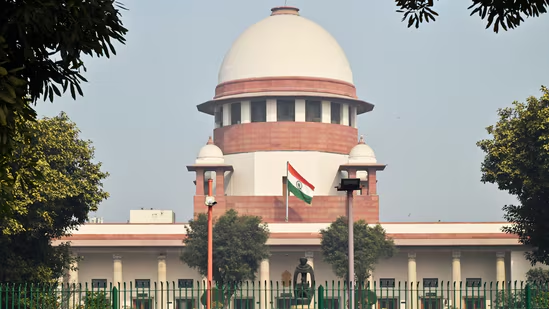
The Supreme Court has denied bail to activists accused in a Delhi riots case, reinforcing a strict judicial stance as investigations continue into allegations of conspiracy, violence, and disruption linked to the 2020 unrest in the national capital.
The Supreme Court bail denial in the Delhi riots case is a time sensitive legal development with wide implications for ongoing prosecutions related to the 2020 violence. The court ruled that the seriousness of the allegations and the stage of the investigation did not justify bail at this point, while clarifying that detailed examination of evidence will take place during trial.
Background Of The Delhi Riots Case
The Delhi riots case stems from violence that erupted in parts of northeast Delhi in February 2020, resulting in multiple deaths, injuries, and large scale property damage. The unrest followed protests and counter protests, which later escalated into communal clashes across several localities.
Investigative agencies registered multiple cases under criminal law, including charges related to rioting, conspiracy, unlawful assembly, and terrorism related provisions. Several activists, students, and organisers were arrested over alleged roles in planning or inciting violence. These cases have since moved through lower courts and reached the Supreme Court through bail petitions.
Supreme Court’s Reasoning For Bail Denial
In denying bail, the Supreme Court observed that the allegations against the accused were grave and involved claims of organised planning rather than spontaneous participation. The court noted that at the bail stage, it is not required to conduct a mini trial or determine guilt, but to assess whether releasing the accused could affect the investigation or trial.
Judges also took into account the volume of material collected by investigating agencies, including statements, digital records, and communication trails. The court held that prima facie findings by lower courts could not be ignored without compelling reasons, especially in cases involving public disorder and national security concerns.
Legal Threshold For Bail In Riot Related Cases
Bail jurisprudence in riot related cases often balances personal liberty against the interests of justice. Courts consider factors such as the nature of the offence, severity of punishment, possibility of witness tampering, and likelihood of the accused influencing the case.
In this instance, the Supreme Court emphasised that prolonged detention alone is not sufficient ground for bail when allegations point towards a structured conspiracy. The court clarified that the accused retain the right to seek bail again if there is a significant change in circumstances, such as prolonged delay in trial or weakening of evidence.
Impact On Ongoing Delhi Riots Trials
The bail denial is expected to influence similar petitions pending before various courts. Legal observers note that the order reinforces a cautious approach in granting bail in cases involving mass violence and alleged coordinated action.
For investigating agencies, the ruling strengthens their position as trials proceed. For the accused and their legal teams, the focus is likely to shift towards expediting trials and challenging evidence during the examination stage rather than relying on interim relief.
Reactions And Civil Liberties Debate
The decision has reignited debate around civil liberties, preventive detention, and the use of stringent laws in protest related cases. Supporters of the accused argue that prolonged incarceration without conviction undermines fundamental rights. They stress the need for speedy trials and proportional application of law.
On the other hand, government representatives and some legal experts argue that large scale violence requires firm legal action to deter future unrest. They maintain that judicial scrutiny at multiple levels ensures procedural safeguards remain intact.
What Happens Next In The Case
Following the Supreme Court’s order, the accused will remain in judicial custody as the trial continues. Lower courts are expected to prioritise examination of witnesses and evidence to avoid unnecessary delays. Defence teams may file fresh bail applications if there are material changes, such as extended trial timelines or contradictions in prosecution evidence.
The Supreme Court has also reiterated that its observations at the bail stage should not prejudice the merits of the case. Trial courts remain free to independently assess evidence and deliver verdicts based on facts and law.
Broader Legal Significance
The ruling highlights the judiciary’s approach to balancing individual rights with public order considerations. It underscores that bail decisions in sensitive cases depend heavily on factual context and investigative progress rather than public narratives.
As Delhi riots cases continue to move through the legal system, this order is likely to be cited as a reference point in future bail hearings involving allegations of organised violence and conspiracy.
Takeaways
Supreme Court denied bail citing seriousness of Delhi riots allegations
Court focused on prima facie evidence and investigation stage
Bail can be reconsidered if circumstances change significantly
Trial courts retain full authority to assess evidence independently
FAQs
Why did the Supreme Court deny bail in the Delhi riots case?
The court cited the gravity of allegations and ongoing investigation as key reasons.
Does this mean the accused are guilty?
No, bail denial does not determine guilt, which will be decided during trial.
Can the accused apply for bail again?
Yes, fresh bail pleas can be filed if there is a change in circumstances.
Will this affect other Delhi riots cases?
The order may influence similar bail petitions but each case will be judged on its own facts.