








Now Reading: ISRO Prepares for Next Gaganyaan Test, Crew Module in Focus
-
01
ISRO Prepares for Next Gaganyaan Test, Crew Module in Focus
ISRO Prepares for Next Gaganyaan Test, Crew Module in Focus
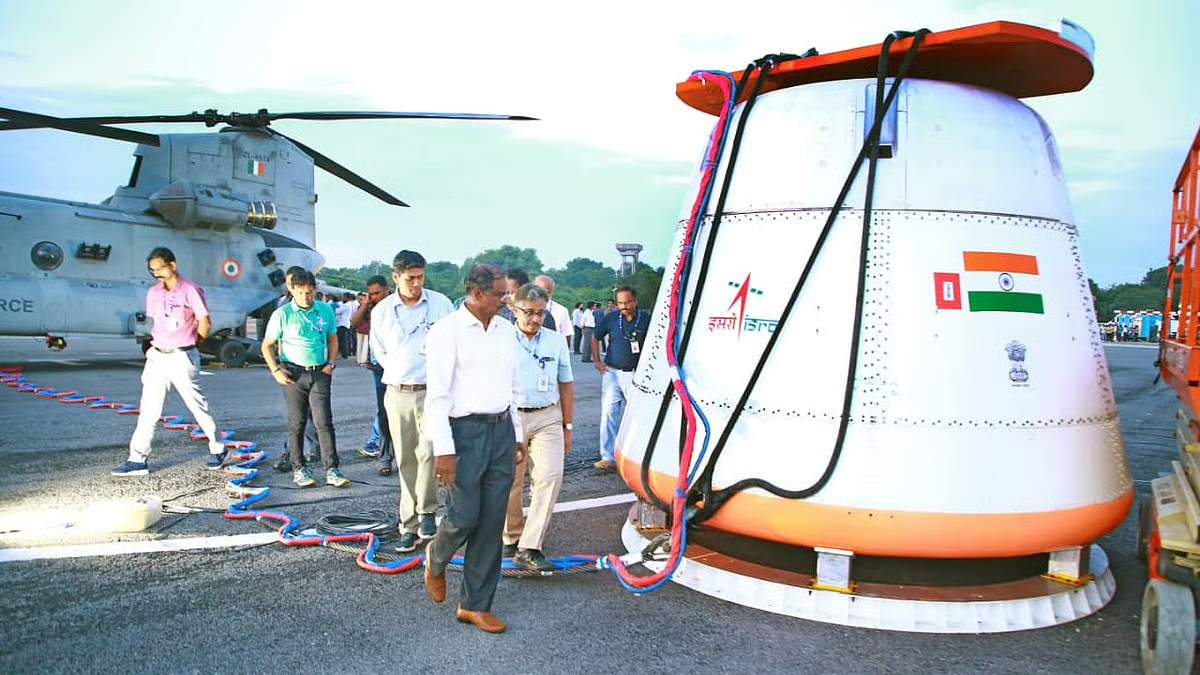
ISRO is preparing for the next Gaganyaan test, with the crew module emerging as the central focus of upcoming missions. The development marks a critical step in India’s human spaceflight programme as systems related to astronaut safety, recovery, and mission reliability undergo advanced validation.
The topic is time sensitive and the tone below follows a factual news reporting style.
Gaganyaan Programme Enters Crucial Testing Phase
The Gaganyaan programme has entered a decisive phase as ISRO prepares for its next test focused on the crew module. This test is part of a sequence of planned missions designed to validate systems required for safely sending humans to space and bringing them back to Earth. The crew module is the section that will carry astronauts during the mission, making its reliability central to the programme’s success.
ISRO’s recent efforts indicate a shift from preliminary demonstrations to more integrated and mission-like testing. Each test aims to reduce risk by validating design assumptions under real flight conditions. Engineers are paying close attention to structural integrity, thermal protection, and onboard systems that support human life during launch, orbit, and re-entry.
Why the Crew Module Is Central to Gaganyaan
The crew module is the most complex and safety-critical component of the Gaganyaan mission. It is designed to protect astronauts from extreme temperatures, pressure changes, and high deceleration forces during re-entry. The upcoming test will focus on validating these capabilities through controlled flight scenarios.
The module includes life support systems, crew seating, parachutes, and recovery mechanisms. Unlike satellite missions, human spaceflight demands zero tolerance for system failure. This is why ISRO is conducting multiple incremental tests rather than a single full-scale mission. Each successful test adds confidence that the module can perform reliably under various contingencies.
Key Objectives of the Upcoming Gaganyaan Test
One of the main objectives of the next Gaganyaan test is to assess the crew module’s performance during descent and recovery. Parachute deployment, stability during atmospheric re-entry, and splashdown accuracy are expected to be closely monitored. These elements are critical to ensuring astronaut safety after mission completion.
The test will also provide data on sensor performance, communication systems, and onboard control mechanisms. Engineers will analyze this data to identify any anomalies and fine-tune systems accordingly. Such iterative testing is standard practice in human spaceflight programmes worldwide and is essential for minimizing mission risk.
Progress Made So Far in Gaganyaan Development
ISRO has already completed several key tests related to the Gaganyaan mission, including abort scenarios and propulsion system evaluations. These tests have demonstrated the agency’s ability to safely separate the crew module from the launch vehicle in emergency situations.
Ground tests and simulation-based evaluations have also played a major role in preparing for the upcoming mission. Human-rated launch systems require extensive validation beyond what is needed for unmanned missions. The steady pace of progress reflects ISRO’s cautious approach, prioritizing safety over speed.
Human Spaceflight Readiness and Training Linkages
While the current focus is on hardware, the Gaganyaan programme also includes parallel efforts in astronaut training and mission planning. The performance of the crew module directly influences training protocols, as astronauts must be familiar with onboard systems and emergency procedures.
Each successful test helps refine mission timelines, crew roles, and recovery operations. This alignment between hardware development and human readiness ensures that the programme advances cohesively rather than in isolation. ISRO officials have emphasized that no human mission will be attempted until all systems meet stringent safety benchmarks.
Strategic Importance of the Gaganyaan Mission
The Gaganyaan programme holds strategic and scientific significance for India. Successfully demonstrating human spaceflight capability places India among a select group of nations with independent crewed mission expertise. Beyond prestige, the mission strengthens domestic capabilities in aerospace engineering, materials science, and systems integration.
The crew module tests also contribute to long-term space ambitions, including future space station plans and extended human missions. Technologies validated during Gaganyaan can be adapted for more complex missions in the coming decades.
What to Expect After the Upcoming Test
Following the next Gaganyaan test, ISRO is expected to conduct detailed post-mission analysis before announcing subsequent steps. Any identified issues will be addressed through design refinements and additional validation tests. This cautious progression ensures that lessons learned are fully incorporated into future missions.
Observers anticipate that multiple crew module-related tests will be conducted before a final uncrewed orbital mission. Only after meeting all safety and performance criteria will ISRO move closer to a human spaceflight attempt.
Takeaways
ISRO is advancing toward its next Gaganyaan test with focus on the crew module
Crew module safety and recovery systems are central to mission success
Incremental testing reflects a cautious and methodical approach
Gaganyaan strengthens India’s long-term human spaceflight capabilities
FAQs
What is the main purpose of the upcoming Gaganyaan test?
The test aims to validate the crew module’s performance during descent, recovery, and safety-critical phases.
Why is the crew module so important in Gaganyaan?
It houses astronauts and must protect them during launch, spaceflight, and re-entry, making it the most critical component.
Has ISRO conducted similar tests before?
Yes, ISRO has completed abort and system-level tests as part of the phased Gaganyaan development plan.
When will India send astronauts under Gaganyaan?
A human mission will be attempted only after all required uncrewed tests and safety validations are successfully completed.