






Now Reading: Centre Likely To Extend Free Ration Scheme Beyond March 2026
-
01
Centre Likely To Extend Free Ration Scheme Beyond March 2026
Centre Likely To Extend Free Ration Scheme Beyond March 2026

The Centre is likely to extend the free ration scheme beyond March 2026 as food security remains a priority for millions of beneficiaries across India. The move is being considered amid inflation pressures, uneven income recovery, and continued dependence on subsidised food grains.
The free ration scheme, implemented under the National Food Security Act, currently provides wheat and rice at no cost to eligible beneficiaries. With the March 2026 deadline approaching, policy signals suggest the government is preparing to continue the programme to avoid disruption in food access for vulnerable households.
Government Signals Indicate Continuity Of Free Ration Scheme
The free ration scheme has evolved into one of the largest social welfare programmes in the country, covering more than 80 crore people. Since the pandemic, the Centre has absorbed the full cost of food grains, eliminating the earlier nominal charges for beneficiaries. Internal assessments reportedly show that food inflation and employment volatility continue to affect low income groups, especially in rural and informal urban sectors.
Officials tracking welfare spending indicate that withdrawing the scheme abruptly could lead to nutritional stress and political backlash. The Centre is therefore exploring budgetary provisions to sustain free distribution beyond March 2026, potentially with minor operational tweaks rather than a complete overhaul.
Economic Context Driving Extension Discussions
Rising food prices, uneven monsoon outcomes in recent years, and global commodity volatility have kept food security on the policy radar. While overall inflation has moderated compared to pandemic highs, essentials such as cereals and pulses remain sensitive to supply disruptions. The free ration scheme acts as a buffer against these shocks for millions of households.
Labour market data also suggests that wage growth in informal sectors has not kept pace with living costs in many regions. In such a scenario, extending free ration support helps stabilise household consumption and reduces pressure on state level welfare systems.
Budgetary Impact And Food Corporation Role
Extending the free ration scheme beyond March 2026 will have significant fiscal implications. Annual food subsidy expenditure has already crossed previous pre pandemic levels, with procurement, storage, and distribution costs forming a major component. The Food Corporation of India plays a central role in managing grain stocks and logistics for the scheme.
Policy planners are reportedly examining ways to optimise procurement cycles, reduce storage losses, and improve digital tracking of beneficiaries. Any extension decision is expected to balance fiscal discipline with social welfare priorities, especially ahead of future economic uncertainties.
State Governments And Political Considerations
State governments have consistently backed the continuation of the free ration scheme, citing its direct impact on poverty alleviation and food security. For many states, the central scheme reduces the burden on their own food subsidy programmes and allows funds to be redirected to other development sectors.
Politically, the scheme enjoys broad acceptance across regions and income groups. Its extension beyond March 2026 would align with the Centre’s broader narrative of inclusive growth and welfare continuity, especially in states with high dependence on public distribution systems.
What Beneficiaries Can Expect If Extension Is Approved
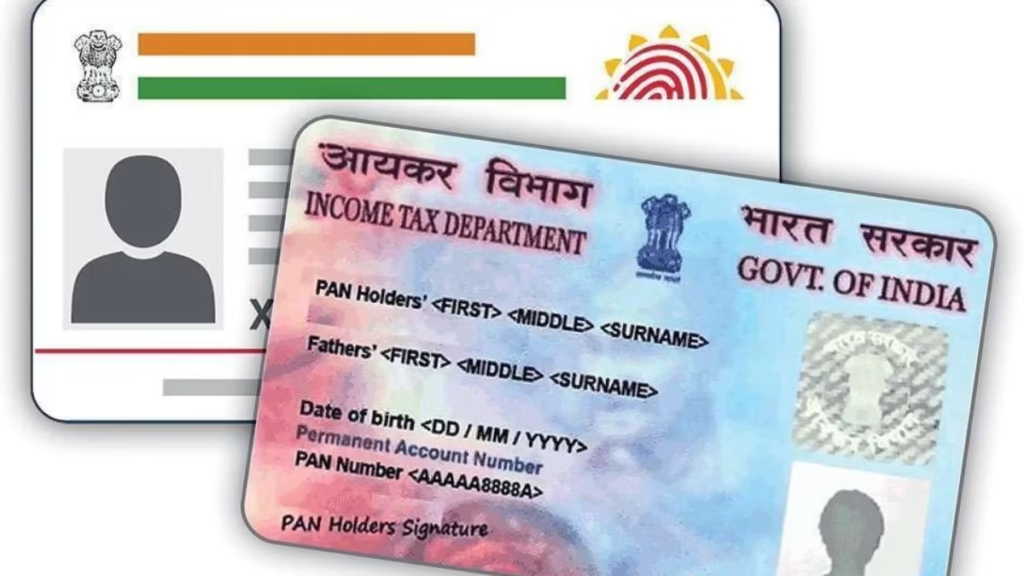
If the Centre formally approves the extension, beneficiaries are unlikely to see major changes in entitlement quantities or eligibility criteria in the short term. Wheat and rice distribution is expected to continue under existing norms, with Aadhaar linked authentication and ration card portability remaining in place.
There may be increased focus on updating beneficiary databases to eliminate duplication and ensure targeted delivery. Nutrition diversification, such as inclusion of millets through pilot programmes, could also be explored as part of long term food security planning.
Timeline And Next Policy Steps
While no official announcement has been made yet, internal discussions typically translate into cabinet level decisions closer to the deadline. A formal extension notification is expected before March 2026 to ensure uninterrupted distribution across states and union territories.
The Centre is likely to use the upcoming budget cycles to signal its intent, with allocations reflecting the expected continuation of free ration benefits. Stakeholders across government departments are preparing operational plans assuming the scheme remains in force beyond the current term.
Takeaways
- The Centre is likely to extend the free ration scheme beyond March 2026 to maintain food security.
- Economic pressures and inflation remain key reasons behind the proposed continuation.
- The move will have major fiscal implications but strong political and social backing.
- Beneficiaries are expected to see continuity rather than major changes in entitlements.
FAQs
Is the free ration scheme officially extended beyond March 2026?
No formal notification has been issued yet, but strong policy signals suggest an extension is being prepared.
Who benefits from the free ration scheme?
Eligible beneficiaries under the National Food Security Act, covering over 80 crore people, receive free wheat and rice.
Will the quantity of free ration change after March 2026?
Current indications suggest quantities and eligibility norms will remain unchanged in the initial phase of any extension.
Why is the Centre considering an extension now?
Ongoing inflation, income uncertainty, and the need to ensure food security for vulnerable populations are key factors.