






Now Reading: Devendra Fadnavis Orders Probe into Illegal Sale of Government Land Linked to Ajit Pawar’s Sons’ Firm
-
01
Devendra Fadnavis Orders Probe into Illegal Sale of Government Land Linked to Ajit Pawar’s Sons’ Firm
Devendra Fadnavis Orders Probe into Illegal Sale of Government Land Linked to Ajit Pawar’s Sons’ Firm
Introduction:
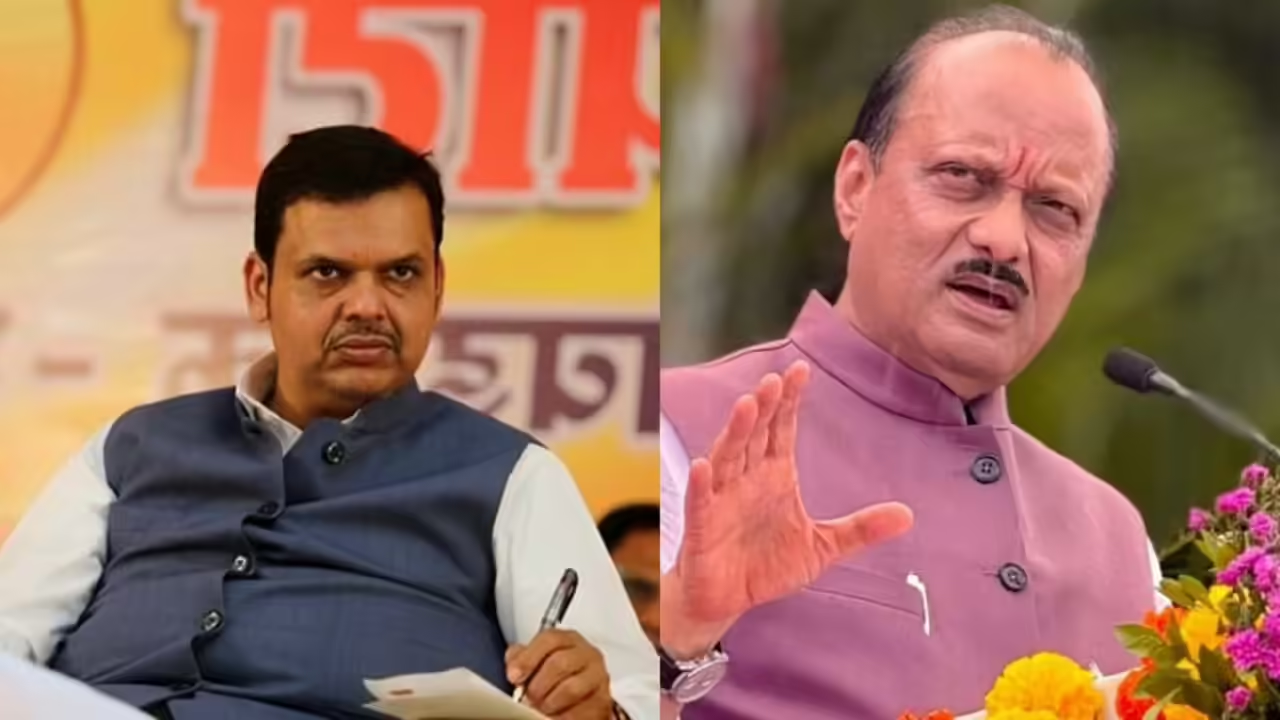
Deputy Chief Minister Devendra Fadnavis has ordered a high-level investigation into the alleged illegal sale of government land to a company associated with the sons of Maharashtra Deputy Chief Minister Ajit Pawar. The controversy involves claims of an irregular transfer of prime government property in Pune, where stamp duty worth over ₹21 crore was reportedly waived. The issue has stirred political debate across the state, with opposition parties demanding accountability and transparency.
Probe initiated after irregularities surface
According to preliminary reports, the land in question belongs to the state’s irrigation department. It was allegedly sold to a private firm linked to Ajit Pawar’s family under questionable circumstances. The deal raised red flags after internal audits revealed that standard procedures were bypassed and the state exchequer may have suffered significant losses due to the waiver of stamp duty.
Fadnavis directed senior officials to launch an immediate inquiry and submit a detailed report within a specified time frame. A senior official has already been suspended pending investigation.
Political ripples in Maharashtra
The case has triggered a fresh wave of political tension in Maharashtra’s ruling coalition. While Fadnavis maintained that the investigation will be fair and fact-based, opposition parties have accused the government of shielding influential figures. They allege that the waiver of such a large stamp duty sum could not have been processed without political intervention.
Leaders from the BJP have defended the probe, claiming it reflects the administration’s commitment to transparency and zero tolerance for corruption—regardless of political affiliations.
Ajit Pawar’s response and public scrutiny
Ajit Pawar, known for his long political career and significant influence in the state’s power structure, has not issued a direct public statement yet. However, sources close to him insist that his family’s business interests have operated within legal frameworks. They argue that the allegations are politically motivated, surfacing conveniently ahead of upcoming civic polls.
Public sentiment, meanwhile, remains mixed. Many citizens in Pune and nearby regions have expressed frustration over recurring instances of alleged land scams involving political figures, questioning the accountability mechanisms in state governance.
Impact on government credibility
The incident has put additional pressure on the Maharashtra government, already under scrutiny for multiple land and development-related controversies. Fadnavis’s decision to order an inquiry has been seen as a move to protect administrative integrity and contain political damage. Yet, critics argue that suspending one official is not enough and that the entire transaction trail must be made public.
Legal experts point out that if the land transfer violated government norms or the Maharashtra Land Revenue Code, it could lead to serious penalties, including reversal of the sale and criminal proceedings against those responsible.
A test for political ethics and governance
This case is not just about one land deal—it raises deeper questions about how public property is managed in India’s rapidly growing urban centers. Pune, being one of Maharashtra’s most commercially active cities, has seen rising land values and increasing disputes over government land sales. The probe ordered by Fadnavis is being viewed as a litmus test for administrative transparency and the government’s resolve to act against misconduct, irrespective of rank or relation.
If the investigation is pursued with full transparency, it could set a precedent for future cases involving misuse of public assets. However, if it fades into political back-and-forth, it risks eroding public trust in the system further.
Conclusion:
As Maharashtra’s leadership navigates this sensitive controversy, the spotlight remains firmly on how the government handles its own accountability. The outcome of the probe will determine not only the credibility of the current administration but also how seriously India’s political class treats issues of public property and institutional integrity.