








Now Reading: GPS spoofing near Delhi airport raises serious flight safety concerns
-
01
GPS spoofing near Delhi airport raises serious flight safety concerns
GPS spoofing near Delhi airport raises serious flight safety concerns
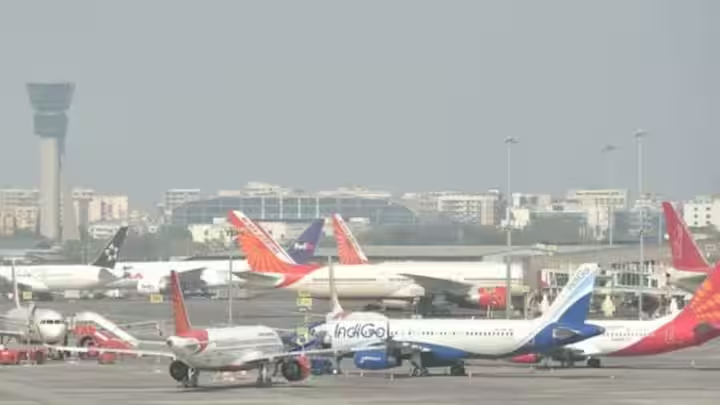
A series of GPS spoofing incidents near Delhi airport has triggered fresh scrutiny over flight safety as aviation authorities investigate unusual navigation disruptions reported by multiple aircraft. The main keyword GPS spoofing appears at the center of growing concerns about interference affecting approach paths in one of India’s busiest airspaces.
Reports indicate rising navigation anomalies in critical airspace
Initial assessments suggest that several aircraft approaching or departing from the Delhi airspace experienced abnormal GPS readings, prompting flight crews to switch to alternate navigation systems. The subhead includes the secondary keyword flight navigation systems. Pilots flagged sudden signal deviations and inconsistent positional data while transitioning through high traffic corridors. These anomalies coincided with peak operational hours, raising operational challenges for air traffic controllers managing dense flight movement.
India’s northern airspace handles a large share of domestic and international traffic, particularly during winter months when low visibility operations are common. Any interference during critical flight phases such as approach, descent or landing elevates operational risks. Aviation authorities have asked airlines to maintain heightened vigilance and report all deviations. While the incidents did not result in compromised flight paths, the pattern indicates a possible escalation of signal manipulation attempts, making it a high priority investigation.
Understanding how GPS spoofing can threaten aviation safety
GPS spoofing works by broadcasting fake satellite signals that mislead onboard receivers. The subhead includes secondary keywords cockpit awareness and aviation security. Aircraft rely on satellite based navigation for route accuracy, timing and situational awareness, especially in instrument heavy operations. When fake signals distort readings, flight crews need to rapidly validate their position using alternate systems such as inertial navigation, radio beacons or visual cues if weather conditions allow.
Delhi airport’s winter fog profile adds complexity because the region often depends on instrument landing systems for safe operations. Any unexpected data irregularity forces pilots to cross check multiple systems under time pressure. Modern aircraft have multilayered safeguards, but signal manipulation can disrupt workload distribution in the cockpit, particularly when visibility is low and runway occupancy is high.
Globally, aviation networks have reported similar incidents near conflict zones and dense metropolitan clusters. India has not historically seen frequent spoofing near major airports, which makes the sudden rise in anomalies near Delhi noteworthy. Authorities are evaluating whether the interference is accidental, linked to faulty transmitters or a deliberate attempt to distort signals.
Regulators move to assess risk and strengthen surveillance
Aviation regulators have asked for detailed incident logs from airlines to map the exact coordinates and time windows of the disruptions. The subhead includes secondary keywords airspace monitoring and regulatory action. Data collected from flight recorders, ATC logs and onboard alerts will help determine if the interference originated from ground level emitters or airborne sources.
Security agencies are now scanning nearby zones for unauthorized radio frequency equipment that could mimic satellite signals. Delhi’s periphery includes dense residential pockets, commercial hubs and industrial sites where rogue transmitters could be concealed. The investigation includes cooperation with telecom and spectrum management bodies to identify irregular bursts or abnormal signal concentrations.
Regulators are also reviewing contingency protocols to ensure that airlines follow standard operating procedures during spoofing events. India’s aviation framework requires aircraft to switch to alternative navigation modes, inform ATC immediately and maintain stable flight profiles until the disruption clears. Airlines are conducting internal briefings to equip flight crews with updated guidelines based on the latest alerts.
Impact on airlines, passengers and airport operations
The immediate impact for passengers remains minimal as all affected flights continued safely with standard procedures. The subhead integrates secondary keywords passenger safety and operational continuity. However, repeated spoofing incidents could force airlines to modify approach patterns, introduce additional checks or delay landings during high density periods. Delhi airport, already managing winter fog related challenges, may face more dynamic sequencing if disruptions persist.
For airlines, operational adjustments include revisiting crew training modules, strengthening simulator sessions that replicate GPS failure scenarios and updating internal advisories. Aircraft operating older navigation systems may require additional calibration to ensure redundancy layers work seamlessly. Pilots have highlighted the need for rapid dissemination of NOTAMs specifying affected zones to improve situational awareness.
From a long term perspective, persistent signal interference near a major international airport raises strategic concerns. India is investing heavily in satellite based augmentation systems that improve navigation accuracy across the subcontinent. Spoofing incidents undermine trust in these systems and could encourage accelerated deployment of additional monitoring infrastructure around key airports.
Takeaways
Multiple aircraft near Delhi airport reported GPS signal anomalies.
Authorities suspect GPS spoofing and have launched a detailed investigation.
Airlines are reinforcing pilot protocols and updating navigation readiness.
Persistent interference could affect operations during Delhi’s winter fog season.
FAQs
What triggered the investigation into GPS spoofing near Delhi airport?
Reports from pilots about abnormal GPS readings and inconsistent positional data prompted regulators to examine possible spoofing activity.
Did the incidents affect flight safety directly?
No flight paths were compromised. Pilots used alternate navigation systems as per standard procedure and continued safe operations.
How does GPS spoofing impact aircraft?
It feeds receivers with false location data, forcing pilots to cross check systems and switch to reliable backups during critical phases of flight.
What steps are authorities taking now?
Regulators are collecting incident data, inspecting spectrum activity and coordinating with security agencies to identify the source of the interference.