





Now Reading: India-Nepal Amend Transit Protocol to Launch New Rail Link
-
01
India-Nepal Amend Transit Protocol to Launch New Rail Link
India-Nepal Amend Transit Protocol to Launch New Rail Link
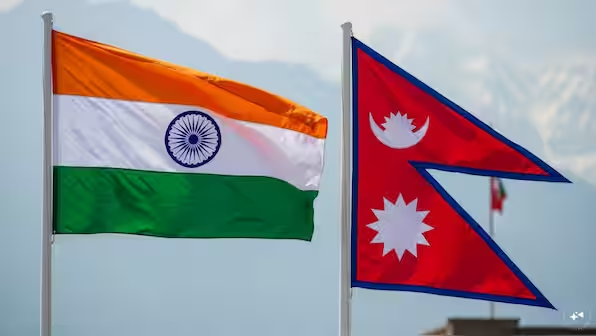
India and Nepal have signed a significant Letter of Exchange (LoE) to amend the transit protocol, opening the main rail corridor between Jogbani in India and Biratnagar in Nepal for direct freight movement. This move is set to reshape trade and connectivity in South Asia.
Expanded Rail Freight between India and Nepal
The recent amendment enables rail-based freight, including both containerised and bulk cargo, to move directly along the Jogbani–Biratnagar corridor. Previously, much of Nepal’s international freight transited via road or indirect modes. Now, Indian ports like Kolkata and Visakhapatnam will feed cargo to Nepal’s customs yard in Morang district near Biratnagar, marking a leap in multimodal transit. The LoE also broadened transit rights and applied to corridors such as Kolkata–Jogbani, Kolkata–Nautanwa (Sunauli) and Visakhapatnam–Nautanwa, deepening Nepal’s access to Indian infrastructure. The rail link itself was inaugurated in June 2023, built with Indian grant assistance and now fully operational under the new protocol.
Strategic Implications for Trade and Infrastructure
For Nepal the new corridor means reduced logistics cost and faster cargo movement from Indian ports to Nepali destinations. Bulk goods such as food grains, fertilisers, construction materials and general cargo can now shift from road-only transit to rail-plus-road, boosting Nepal’s trade competitiveness. For India the arrangement underpins its “Neighbourhood First” policy and strengthens its role as Nepal’s largest trade and investment partner. The enhanced rail link supports deeper regional supply chains, port-based logistics and improved border infrastructure. The amendment signals India’s intention to build infrastructure-led connectivity rather than relying solely on roads.
Operational, Legal and Logistical Changes
The amendment to the Treaty of Transit’s protocol introduces expanded definitions of “bulk cargo” and “containerised freight”, clear rail transit routes, and multimodal linkages. The Jogbani–Biratnagar section will now serve as the key node, with Indian ports feeding cargo to Nepal via rail then onward by road or rail within Nepal. Integrated Check Posts (ICPs), customs yard upgrades and freight terminal facilities at Morang have been factored in. The legal framework now allows Nepal to use Indian port infrastructure more directly, facilitating access to third-country markets through Indian ports. The logistics chain will require coordination between Indian Railways, Nepal Railways, customs authorities, port terminals and freight forwarders.
Challenges and Future Prospects
Implementation will require careful management of cross-border standards, rail gauge compatibility, customs clearance systems and transport corridors inside Nepal. While the rail link is operational, its full freight potential depends on last-mile connectivity in Nepal, warehousing facilities and multimodal transitions. Capacity constraints, border process delays and infrastructure bottlenecks remain. Looking ahead, the corridor model sets precedence for further India-Nepal connectivity projects such as extension of rail to other Nepali districts, increased private sector freight participation and integration with wider regional networks (for example Bangladesh or Bhutan). The transit link enhances regional integration, supply-chain resilience and economic growth for both countries.
Takeaways
- The Jogbani–Biratnagar rail link is now officially open for containerised and bulk freight under the amended transit protocol.
- Nepal gains enhanced access to Indian ports and reduced logistics cost; India strengthens its regional connectivity role.
- Legal updates now permit multimodal transit freight via Indian ports to Nepal and onward access to third-country trade.
- Realising full benefits will require investment in customs, warehousing, freight terminals and Nepal’s infrastructure.
FAQs
Q: What exactly did India and Nepal agree on?
A: They exchanged a Letter of Exchange amending the Protocol to the Treaty of Transit so that rail-based freight (both containerised and bulk) can move directly between Jogbani (India) and Biratnagar (Nepal) and via Indian ports such as Kolkata and Visakhapatnam.
Q: How will this affect Nepal’s trade logistics?
A: Nepal will now enjoy reduced transport times and costs as more freight moves by rail from Indian ports rather than exclusively by road. This opens up easier access to Indian port infrastructure and third-country markets.
Q: What are the main corridors affected by this amendment?
A: The amendment covers corridors such as Kolkata–Jogbani, Kolkata–Nautanwa (Sunauli) and Visakhapatnam–Nautanwa (Sunauli) for multi-modal trade movements.
Q: What challenges remain for this rail link to deliver full benefits?
A: Key challenges include enhancing last-mile connectivity in Nepal, establishing efficient customs and freight terminals, ensuring rail/road logistics alignment, and building the infrastructure for container handling and warehousing.