





Now Reading: India’s Clean Energy Push Slows Emissions Growth Even Amid Global Highs
-
01
India’s Clean Energy Push Slows Emissions Growth Even Amid Global Highs
India’s Clean Energy Push Slows Emissions Growth Even Amid Global Highs
India’s clean energy push has contributed to a slowdown in its emissions growth, while global emissions have hit record levels. The primary keyword India emissions slowdown signals how expanded renewables, reduced coal growth and energy efficiency gains are influencing the country’s carbon trajectory.
Global carbon emissions from fossil fuels are projected to hit a record 38 billion tonnes in 2025, marking about a 1.1 % rise over the previous year. Meanwhile India’s carbon dioxide emissions from fossil fuel sources are estimated to grow by only about 1.4 % in 2025—down from previous years. This contrast highlights how India’s clean energy expansion is helping moderate its growth in emissions even as the world continues to emit more.
Clean energy growth and its impact on India’s carbon intensity
India’s renewable energy capacity has grown substantially, covering solar, wind, hydro and nuclear additions. The growth has allowed the power sector to shift away from coal in some regions and reduce fossil fuel generation volumes for the first time in decades. This transition has a direct bearing on the country’s emissions.
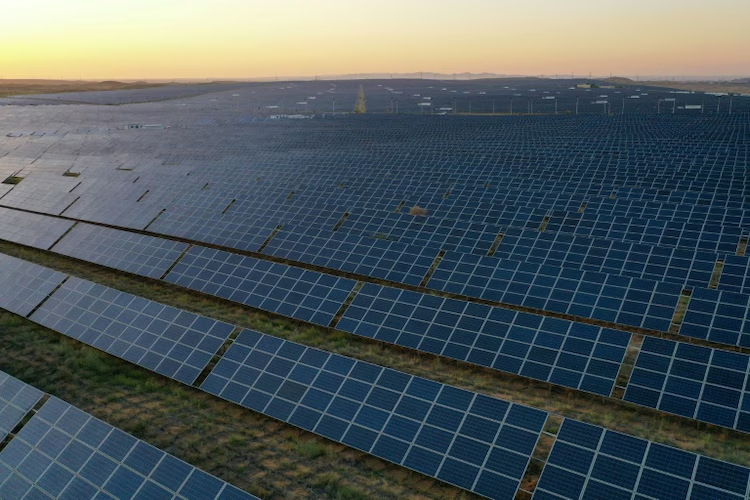
Large-scale solar installations in states such as Rajasthan, Gujarat and Tamil Nadu, combined with accelerated wind farm commissioning, have added several gigawatts of capacity. As a result, fossil-based generation and coal consumption growth have both slowed. Strong monsoons and mild weather in 2025 also reduced cooling demand, limiting the growth of coal use further.
Lower emissions growth should not be mistaken for a decline in absolute emissions. India’s overall emissions continue to rise, but at a slower rate. The drop in growth rate signals improvements in carbon intensity—emissions emitted per unit of economic output. For an economy growing rapidly, improving carbon intensity is essential.
Global emissions trajectory and India’s relative position
Globally, the increase in emissions underlines how far the world remains from the 1.5 °C climate goal. Developed and developing economies alike are still adding emissions rather than cutting them. India, while still increasing emissions, is on a path of slower growth compared to its historical trend.
India now emits roughly 3.2 billion tonnes of CO₂ from fossil fuel use annually, compared with past years when growth rates were double or more. Its growth has slowed partly due to improved energy efficiency, renewables, and policies targeting emission intensity. For instance, coal-fired generation in parts of India declined in the first half of 2025.
In global terms, India’s per-capita emissions remain well below those of many advanced economies, which bolsters its case in international climate negotiations for differentiated responsibility. At the same time, the country’s slower emissions growth gives it strategic space to manage a just transition rather than face disruptive cuts.
Sectoral insights: where gains are happening and where risks remain
In the power sector, clean energy additions have been notable. Wind and solar together grew by 20-30 % year-on-year in some recent months. Hydropower and nuclear also contributed incremental supply. These changes helped reduce fossil-fuel based dispatch, especially when demand growth remained moderate.
But emission risks persist in sectors like industry, transport and construction. Steel, cement, petrochemicals and vehicles continue to rely heavily on fossil fuels. As India’s economy expands, demand for these sectors will rise, making the decarbonisation challenge more complex.
Additionally, while renewable capacity is rising, other factors such as land-use change, methane emissions, coal-plant efficiency, and grid integration remain critical. Emissions from deforestation and forest degradation may decline, but they still contribute significantly to the climate equation.
Policy, investment and future outlook
India’s policy framework supports its emission slowdown. Targets such as 500 GW of non-fossil capacity by 2030, increasing the share of non-fossil electricity, and promoting electric mobility all align with moderate emission growth. The country also emphasizes technology partnerships, domestic manufacturing of renewables, and energy efficiency programs across industries and buildings.
Investment flows into renewables, green hydrogen, storage technologies and grid-scale batteries are increasing. These investments will determine whether the emission growth further slows or begins to decline. For emissions to peak and fall, India will need sustained policy support, private investment, and international cooperation.
Looking ahead, India’s ability to decouple economic growth from emissions will be key. If the clean energy push maintains pace and sectors like heavy industry adapt, India could see its emissions peak in the next decade—an important milestone for the global climate agenda.
Takeaways
- India’s clean energy expansion has helped slow its emissions growth to ~1.4 % in 2025, even as global emissions reach record highs.
- Renewable energy additions, mild weather and reduced coal use are contributing to improved carbon intensity in India.
- Despite gains, sectors like industry, transport and construction still pose major decarbonisation challenges.
- Sustained policy, investment and grid integration will determine whether India’s emissions trajectory shifts toward an absolute decline.
FAQs
Q: Is India’s emissions growth actually decreasing?
A: Not yet. India’s absolute emissions are still increasing, but the rate of growth has slowed significantly.
Q: Why are global emissions still increasing despite clean energy growth?
A: Because many countries are expanding fossil fuel use to meet demand, and growth in renewables has not yet offset that expansion globally.
Q: Which sectors in India remain the biggest emission risks?
A: Heavy industry (steel, cement), transport, construction and coal-based generation remain major challenges for emission reduction.
Q: Can India’s clean energy push bring emissions down in absolute terms soon?
A: Potentially yes, but it depends on rapid deployment of renewables, phasing out fossil-fuel reliance and improving efficiency across all sectors.