








Now Reading: ISRO Year in Review: Major Space Missions Completed in 2025
-
01
ISRO Year in Review: Major Space Missions Completed in 2025
ISRO Year in Review: Major Space Missions Completed in 2025
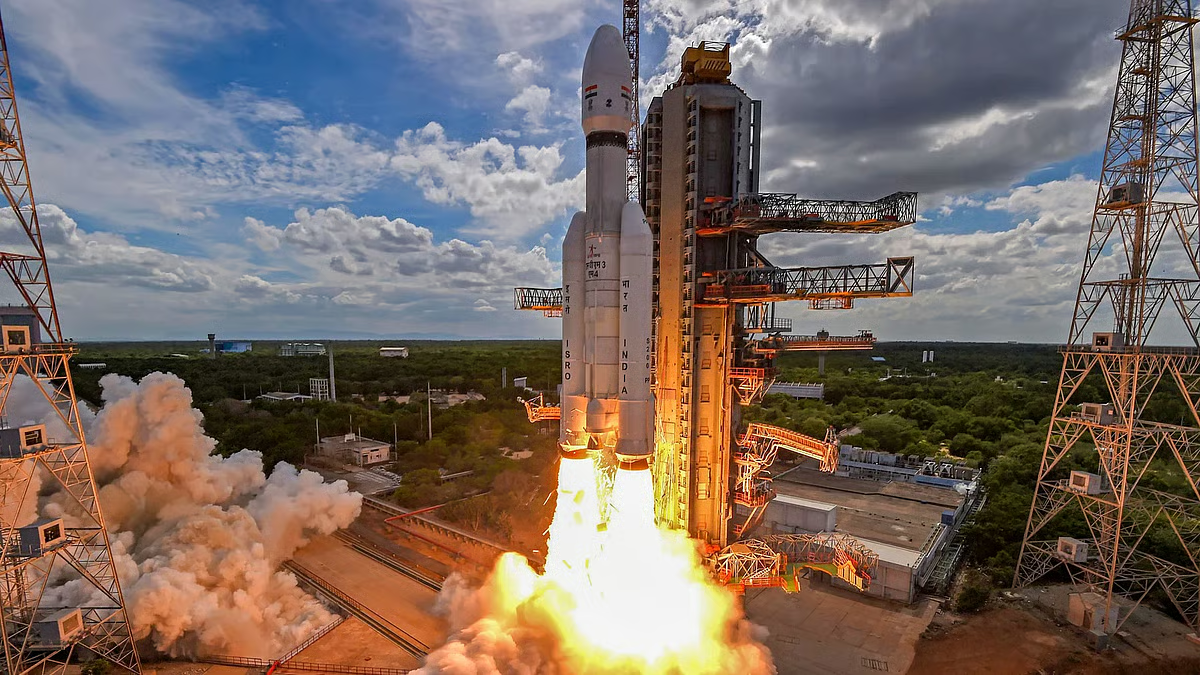
ISRO Year in Review 2025 highlights a year of mission completions that strengthened India’s space capabilities across science, navigation, Earth observation, and technology demonstration. The successful execution of multiple missions reaffirmed ISRO’s operational reliability and long-term strategic direction.
The ISRO Year in Review 2025 reflects a time sensitive news analysis, as the missions discussed were completed within the calendar year and shaped India’s space roadmap going forward. The year focused on execution rather than announcements, with emphasis on mission outcomes, data delivery, and system validation.
Navigation and Earth Observation Missions Strengthened Core Capabilities
A major focus area in the ISRO Year in Review 2025 was the completion of key navigation and Earth observation missions. The Indian Regional Navigation Satellite System continued to receive upgrades, improving positional accuracy and service reliability for civilian and strategic users. These satellites play a critical role in transportation, disaster management, and timing applications.
Earth observation missions completed in 2025 expanded India’s ability to monitor agriculture, urban growth, water resources, and climate patterns. High resolution imaging satellites delivered consistent data to national agencies and state governments. The improved revisit frequency helped in flood mapping, crop assessment, and infrastructure planning, reinforcing space based decision support across sectors.
Aditya L1 Mission Achieves Full Operational Phase
One of the most significant milestones reviewed in the ISRO Year in Review 2025 was the transition of the Aditya L1 solar mission into its full operational phase. Positioned at the Sun Earth Lagrange Point 1, the mission completed all major deployment and calibration activities during the year.
Scientific instruments onboard began delivering continuous observations of the solar corona, solar wind, and magnetic field variations. These datasets are crucial for understanding space weather and its impact on satellite operations, communication systems, and power grids on Earth. The mission marked India’s first successful long term solar observatory beyond low Earth orbit.
Technology Demonstration Missions Validate Future Systems
Technology validation formed a critical component of ISRO’s 2025 mission portfolio. Multiple technology demonstration missions completed their objectives, testing advanced propulsion systems, autonomous navigation, and reentry technologies. These missions are designed to reduce risk for future human spaceflight and deep space exploration programs.
Reusable launch vehicle related experiments conducted earlier progressed through data analysis and validation stages in 2025. The findings confirmed design assumptions and performance metrics, moving ISRO closer to cost efficient access to space. Such technology driven missions do not attract public attention immediately but are foundational for long term capability building.
Launch Vehicle Reliability Maintained Throughout the Year
The ISRO Year in Review 2025 also underscores the consistent performance of India’s launch vehicle fleet. Polar Satellite Launch Vehicle and Geosynchronous Satellite Launch Vehicle missions completed during the year achieved their target orbits with high precision. This reliability reinforced confidence among domestic stakeholders and international partners.
Operational efficiency improvements reduced turnaround time between launches. The ability to support multiple missions in a year without major anomalies demonstrated maturity in systems engineering and mission planning. These outcomes are especially important as India prepares for higher launch frequencies in the coming decade.
Science and Data Delivery Take Center Stage
Beyond launches and deployments, 2025 was a year where scientific output gained prominence. Missions completed earlier transitioned into full data dissemination modes. Research institutions and universities gained access to calibrated datasets for atmospheric studies, oceanography, and planetary science.
ISRO’s emphasis on open data platforms allowed wider academic participation. This shift reflects a move from mission centric success metrics to outcome based evaluation, where the value of a mission is measured by how effectively its data is used for research and governance.
Strategic Outlook After 2025 Mission Completions
As reflected in the ISRO Year in Review 2025, the completion of these missions sets the stage for upcoming initiatives such as human spaceflight and interplanetary exploration. Lessons learned from navigation accuracy, solar observation, and technology validation will directly influence mission design and operational protocols.
The year demonstrated a balanced portfolio approach, combining applied missions with pure science and system testing. This balance is essential for sustaining long term growth while meeting immediate national requirements.
Takeaways
- ISRO completed multiple navigation, Earth observation, and science missions in 2025
- Aditya L1 entered full operational phase delivering continuous solar data
- Technology demonstration missions validated systems for future programs
- Launch vehicle reliability remained strong across all completed missions
FAQs
What was the most important ISRO mission in 2025?
The Aditya L1 mission was a major highlight due to its successful transition into full operational solar observation.
Did ISRO launch new satellites in 2025?
Yes, several navigation and Earth observation satellites were successfully launched and commissioned during the year.
How did these missions benefit India directly?
They improved navigation accuracy, disaster monitoring, climate analysis, and scientific research capabilities.
Does this progress support future human spaceflight missions?
Yes, technology validation and launch reliability achieved in 2025 directly support upcoming human spaceflight objectives.