







Now Reading: Major US Automaker Recalls 1.2 Million Vehicles And What India Can Learn
-
01
Major US Automaker Recalls 1.2 Million Vehicles And What India Can Learn
Major US Automaker Recalls 1.2 Million Vehicles And What India Can Learn
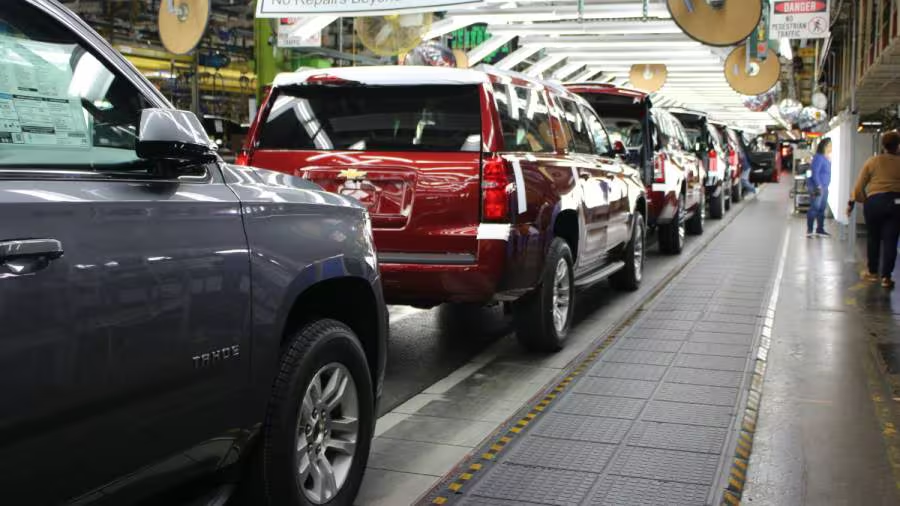
A major US automaker has announced a recall of nearly 1.2 million vehicles, triggering renewed global debate on automotive safety standards. The incident carries important lessons for India’s expanding passenger-vehicle market, especially as local demand accelerates and regulatory expectations rise.
Large scale US recall puts spotlight on global safety expectations
The recall was issued after safety audits flagged a critical defect that could impact vehicle reliability and passenger protection. Although the affected models belong to overseas markets, the scale of the recall is significant enough to influence global discussions on manufacturing standards, component sourcing and post-sale safety monitoring.
For India, which is now among the world’s largest car markets, the event underscores the need to tighten quality oversight and ensure that both domestic and foreign automakers meet high compliance standards. As India pushes deeper into electric mobility and advanced driver assistance systems, the bar for safety accountability continues to rise.
Why large recalls abroad matter for the Indian market
India’s auto sector is increasingly integrated with global supply chains. Many vehicles sold domestically share components, platforms or software systems with international models. A major recall in the US often prompts parallel reviews in other regions because similar engineering principles may be in use.
More importantly, global recalls shape consumer expectations. Indian buyers have become more aware of safety ratings, build quality and after-sales responsiveness. A large foreign recall signals that high-volume manufacturers must be transparent, even if markets differ. It reinforces that modern vehicles require continuous monitoring through software updates, sensor calibration and component traceability.
India’s regulatory framework and gaps exposed by global incidents
While India has strengthened automotive safety norms over the past decade with mandatory airbags, crash-test protocols and emission regulations, gaps remain in recall enforcement, defect reporting and real-time safety tracking.
Recalls in India are still largely voluntary. Although the government has introduced provisions under the Motor Vehicles Act for mandatory recall powers, execution varies. Manufacturers occasionally delay or under-report early defect signals, and communication to buyers is inconsistent.
A key lesson from the US recall is the emphasis on proactive defect identification backed by data. Regulators abroad benefit from extensive reporting from service centres, warranty databases and telematics feedback. India’s fragmented service network and limited centralised data collection reduce the ability to detect early patterns.
The rise of electronics and software increases recall complexity
Modern vehicles rely heavily on sensors, chipsets and software systems. Defects increasingly stem from calibration errors, braking algorithms, battery-management software, thermal-control components or communication modules rather than traditional mechanical failures.
This makes recalls more complex because fixing issues may require over-the-air updates, electronic module replacements or full software revalidation. India’s auto ecosystem must strengthen capabilities to manage software-centric recalls at scale, especially as EV adoption accelerates.
Local manufacturers will need stronger cybersecurity frameworks, better diagnostic tools, and robust vendor controls. Even small firmware errors in power-train or ADAS modules can trigger large scale corrective actions.
Building stronger safety culture across India’s automotive value chain
The US recall also highlights the importance of supplier oversight. Many large global recalls originate from component failures supplied by third-party vendors. India’s auto suppliers are growing rapidly, supporting both domestic OEMs and exports. However, quality assurance maturity varies significantly across Tier-1, Tier-2 and Tier-3 suppliers.
To raise standards, India needs deeper audit mechanisms, component traceability and compliance monitoring across the supply chain. Automakers must invest in long term quality systems rather than only focusing on production output. A recall in one market can damage consumer trust in all markets, making prevention a strategic priority.
How India can strengthen consumer protection and recall responsiveness
Consumer awareness around safety is rising, but many vehicle owners still ignore recall notices or do not know how to check recall status. India can learn from the US system, where recall information is centralised and searchable by VIN, and manufacturers face strict penalties for non-compliance.
Making recall information more visible, creating unified digital dashboards and mandating timely public updates can improve recall success rates. With the rise of connected cars, India could also explore automated recall alerts pushed directly to vehicle infotainment systems or mobile apps linked to the vehicle’s registration.
Takeaways
• Large global recalls emphasise the need for strong Indian safety oversight
• Software centric vehicles require advanced recall and diagnostic capabilities
• Supplier quality systems must mature as India becomes a global manufacturing hub
• Consumer awareness and centralised recall transparency are essential for market safety
FAQs
Q: Does a recall abroad mean the same issue exists in India?
A: Not always. Specifications differ by market, but similar components or software modules may be shared across regions. Indian regulators and automakers typically assess domestic impact after global recall announcements.
Q: Are recalls mandatory in India?
A: India has provisions for mandatory recalls under the Motor Vehicles Act, but most recalls remain voluntary and rely on manufacturers to self-report defects.
Q: Why are recalls becoming more frequent internationally?
A: Cars are more complex today, with higher electronics content, software dependence and tighter global safety regulations. This increases monitoring and error-detection frequency.
Q: How can Indian consumers check if their vehicle is part of a recall?
A: Automakers publish recall information on official websites and contact registered owners. A unified government portal is in development, but consumers should proactively check with dealerships.