








Now Reading: Why India observes National Education Day on 11 November
-
01
Why India observes National Education Day on 11 November
Why India observes National Education Day on 11 November
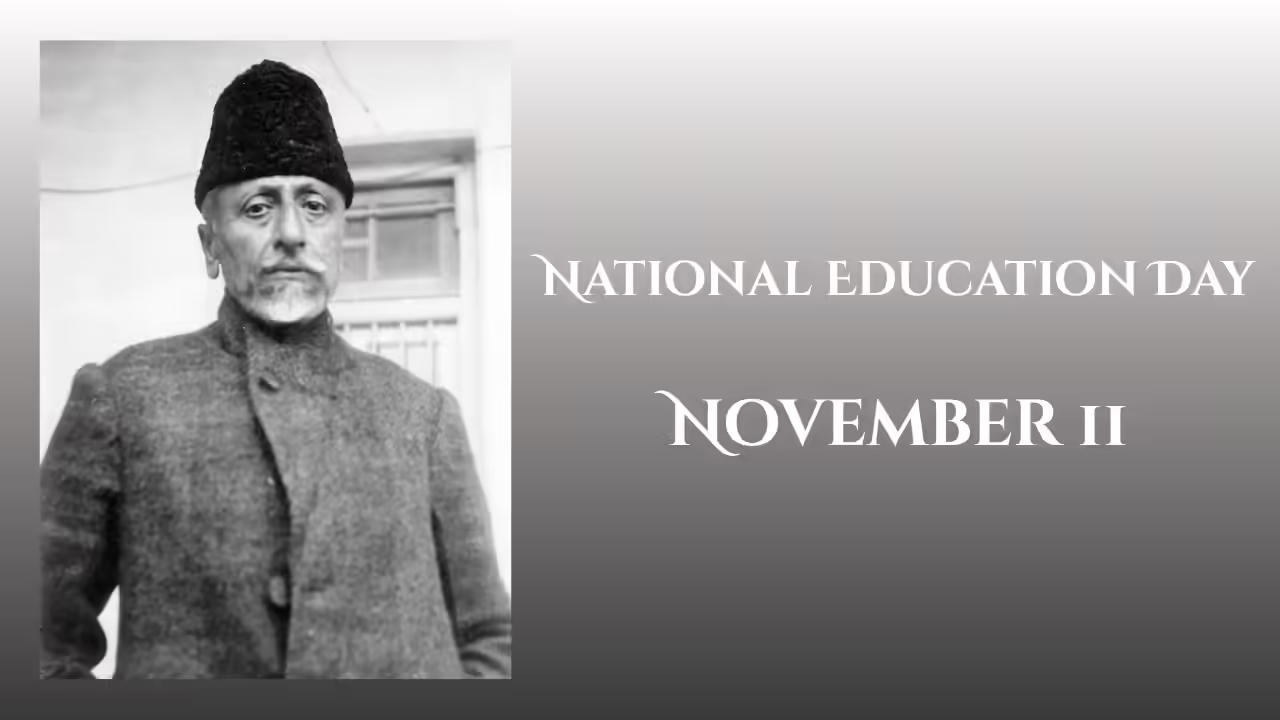
India observes National Education Day on 11 November each year to honor the birth anniversary of Maulana Abul Kalam Azad, the country’s first Minister of Education after independence. The day highlights his role in shaping modern Indian education, expanding access to schooling and laying the foundation for national academic institutions that still influence India’s learning framework today.
National Education Day is marked through essay discussions, teacher training workshops, school exhibitions and seminars that focus on literacy, inclusivity and long term development. The observance has gained more visibility in recent years as conversations about digital learning, student equity and vocational development have become central to policy debates.
Maulana Azad’s role in shaping India’s early education system
When India achieved independence in 1947, the education system faced challenges including low literacy rates, limited school infrastructure and uneven access across rural and urban regions. As the first Minister of Education, Maulana Azad prioritized institution building, curriculum modernization and expansion of public access to schools. His approach focused on balancing cultural identity with scientific and technical progress.
Azad advocated for a national education framework that would not be restricted to elite groups. He emphasized the need for state responsibility in funding schools, teacher training and university development. Under his tenure, the Ministry of Education worked to strengthen primary schooling to ensure foundational literacy while also planning for advanced research institutions.
He supported mother tongue instruction in early education to ensure that children could learn in a familiar language environment. At the same time, he encouraged proficiency in English to help Indian students engage with global academic research and professional opportunities. His balanced approach remains visible in present day policy discussions.
Establishment of national institutions and long term academic vision
Maulana Azad played a central role in establishing the Indian Council for Cultural Relations (ICCR) and promoting cultural exchange as part of national development. He was instrumental in expanding libraries, museums and academic societies to broaden public learning spaces beyond classrooms.
His most enduring contribution was guiding the groundwork for national institutes of higher learning. Institutions like the Indian Institutes of Technology (IITs) and the University Grants Commission (UGC) developed under his strategic direction. The objective was to build centers of excellence that could support India’s technological and industrial growth while maintaining academic independence.
Azad viewed education as a tool not just for employment but for social unity. He believed that strong educational institutions could foster national cohesion across regions, communities and linguistic groups. His policies encouraged scholarship opportunities for disadvantaged groups, although full-scale affirmative access policies took shape later.
National Education Day in the present context
National Education Day events today reflect both historical reflection and contemporary challenges. Schools and universities conduct discussions on how access to quality education continues to shape economic and social mobility. Many events focus on improving teaching methods, expanding digital access and designing skill based curriculum suitable for modern industries.
Recent education reforms, including the National Education Policy (NEP), often draw on Azad’s philosophy of blending traditional knowledge with modern research orientation. The NEP emphasis on multidisciplinary learning, early childhood development and teacher capability enhancement aligns with principles Azad supported more than seven decades ago.
Digital learning adoption during and after pandemic years has raised new questions about access equity. National Education Day discussions now often include topics such as affordable internet, regional language e-learning content and bridging rural digital divides. These concerns are viewed as contemporary extensions of Azad’s vision for inclusive education.
Why the day remains relevant to students and educators
For students, National Education Day serves as a reminder that education is not limited to exam performance. The focus on research, creativity and civic responsibility reflects Azad’s belief that learning should build thoughtful citizens. Schools often encourage project based activities during this observance to help students connect academic knowledge with practical application.
For teachers and academic institutions, the day reinforces professional commitment to teaching quality and continual learning. Workshops emphasize pedagogy improvement, class participation techniques and inclusive teaching strategies. Institutional leadership uses the occasion to evaluate curriculum relevance and alignment with employment and societal needs.
For policymakers, the day reflects long term planning in literacy, higher education access and vocational training. India’s demographic future depends heavily on the capacity of its education system to prepare youth for diversified sectors including manufacturing, technology, healthcare and services. This aligns with Azad’s core idea that education should support both national progress and individual development.